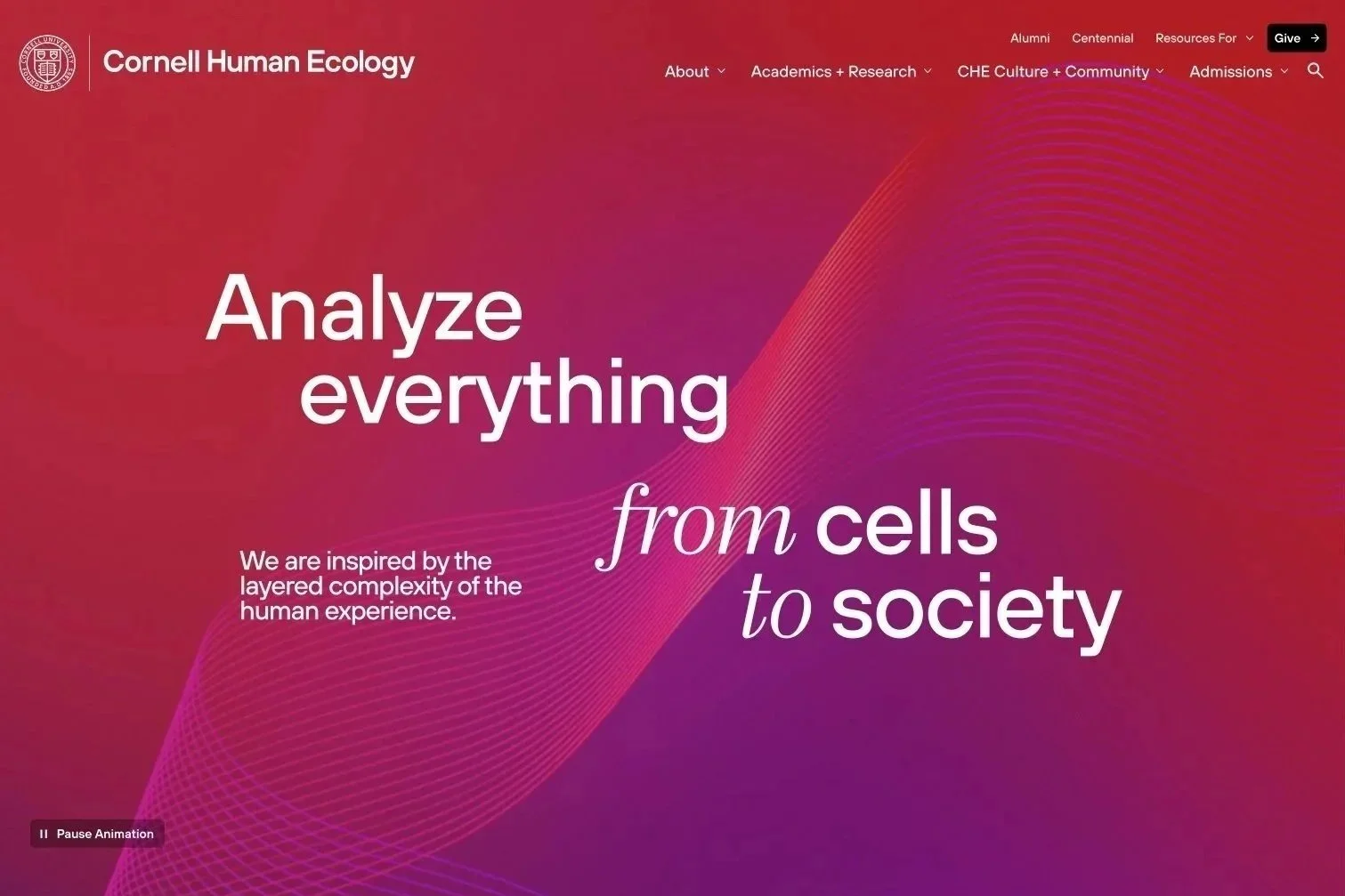
The power to move those who move humanity forward.
Cornell College of Human Ecology (CHE) left audiences struggling to understand what human ecology is and why it matters. The new digital experience needed to unify programs and outcomes under a single vision, showing how the College pushes humanity forward while supplying each person with a sense of purpose and possibility.
I led the end-to-end experience, beginning with discovery research and ending with their new website launch (and everything in between).
We were honored to receive a Webby Award for the work.
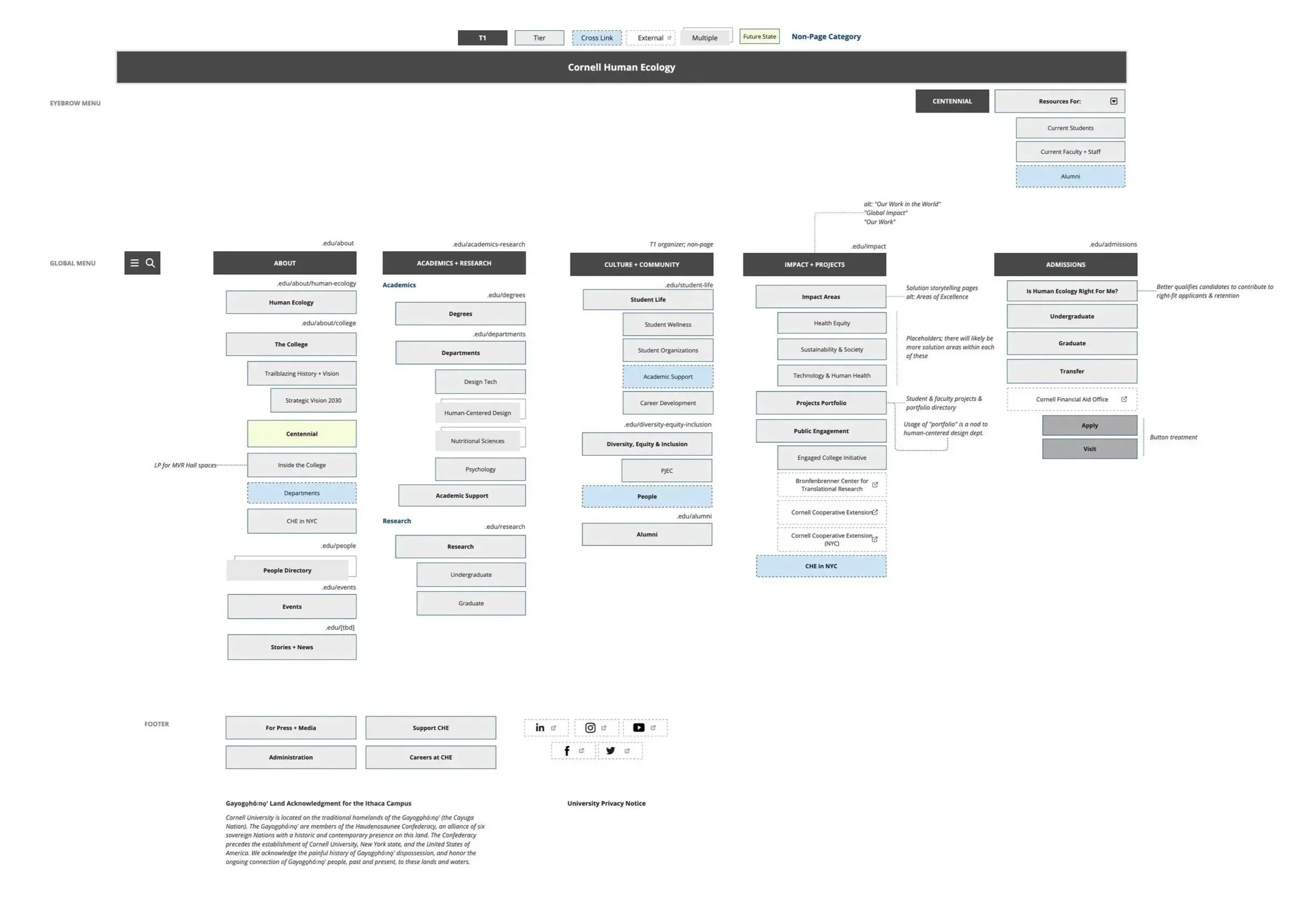
Content and Information Architecture
The College’s challenge was an interesting one. On the one hand, they suffered from egregious overlaps and cross-campus collaborations that made it hard to know what actually “belonged” to them; on the other hand, when you stripped away the overlaps, there wasn’t that much the College could own.
This presented challenges when it came to information architecture, global navigation (within the College and Cornell), and content syndication across the university.
Experience Concepts
To attack the overlap and capture CHE’s brand, our experience concepts had to be powerfully effective—achieving both clarity and design excellence (the College houses a Human Centered Design department).
I passionately pushed for an imperative—“Inviting, not defining”—to avoid overwhelming users with the College’s complexity. Instead we developed a simple boilerplate and impressive design to invite users into the experience.
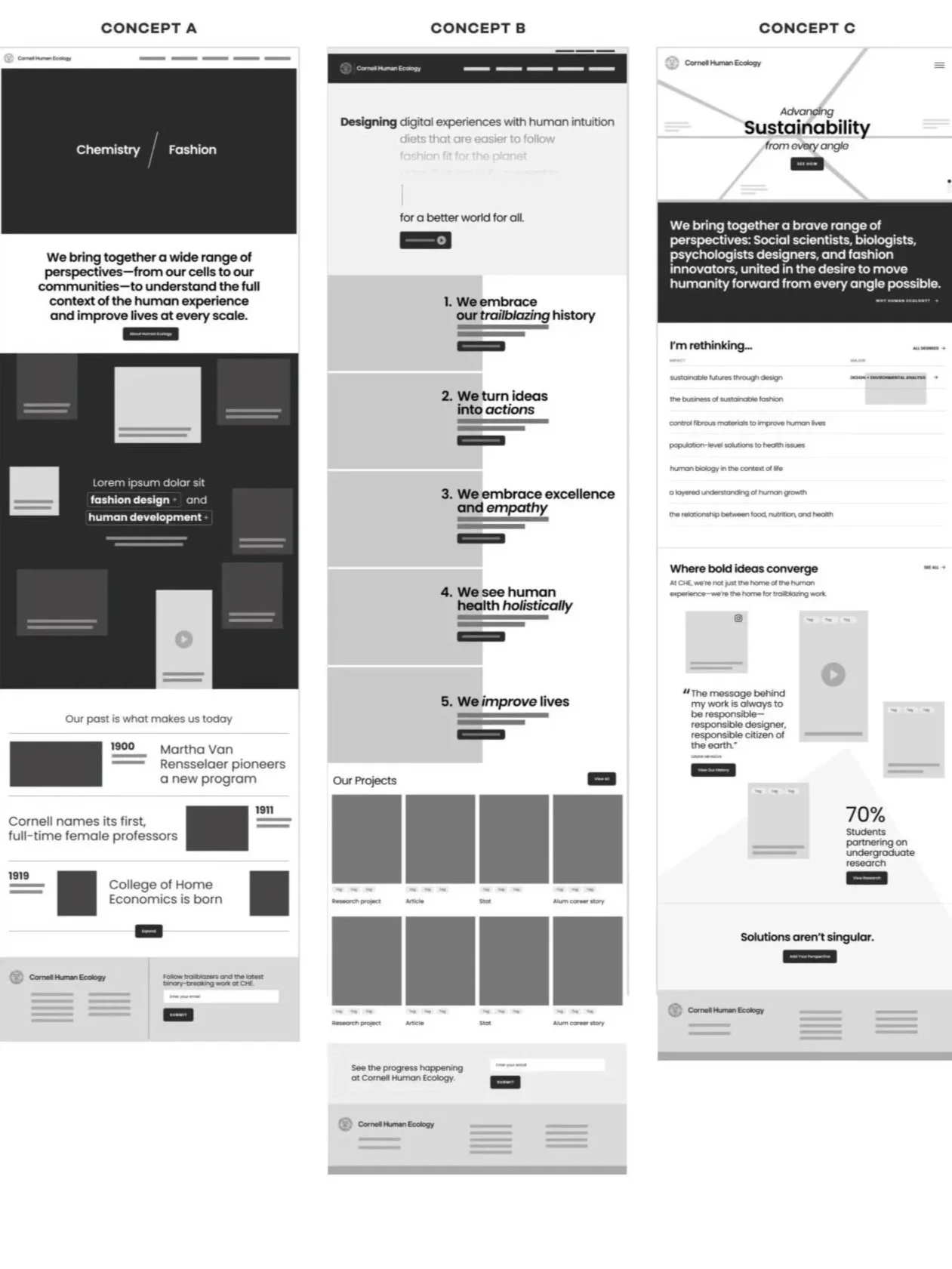
Here are the 3 experience concepts we explored:
Blasting Through Binaries
Inspired by left- and right-brained duality, we enjoyed linking unlikely pairings to demonstrate the power of holistic thinking.
Designing a Way Forward
This concept brought design thinking to life by creating an experience that felt alive and in-the-making.
From Every Angle
We played up angles in this experience, both through angular design and razor-sharp copy. This conveyed the College’s approach of solving humanity’s problems from every angle.